Wireless Sensor Networks for Structural Health Monitoring

Smart wireless nodes for real-time structural diagnostics, safety assurance, and infrastructure lifecycle optimization

Overview

Wireless Sensor Networks (WSNs) are revolutionizing how critical infrastructure is monitored and maintained. These systems consist of spatially distributed sensors capable of detecting, analyzing, and communicating structural and environmental data in real time. By removing the need for heavy cabling and enabling edge-based processing, WSNs provide a lightweight, scalable solution ideal for bridges, tunnels, buildings, dams, and offshore platforms. Whether it’s tracking strain, temperature, tilt, or vibration, these networks offer continuous monitoring that supports predictive maintenance, risk reduction, and extended infrastructure lifecycles.

Enviro Structural Monitoring serves as a trusted B2B provider across North America, offering advanced WSN technologies tailored for smart infrastructure applications. Through our in-house innovations and strategic partnerships, we enable clients to modernize inspection routines and ensure the long-term safety of assets using real-time insights and automated analytics.

A group of illuminated weather monitoring stations stands on a grassy field at night, each equipped with solar panels and mounted on tripods.

Wireless Sensor Networks (WSNs) for SHM

In addition to offering products and systems developed by our team and trusted partners for Wireless Sensor Networks (WSNs) for SHM, we are proud to carry top-tier technologies from Global Advanced Operations Tek Inc. (GAO Tek Inc.) and Global Advanced Operations RFID Inc. (GAO RFID Inc.). These reliable, high-quality products and systems enhance our ability to deliver comprehensive technologies, integrations, and services you can trust. Where relevant, we have provided direct links to select products and systems from GAO Tek Inc. and GAO RFID Inc.

Core Components

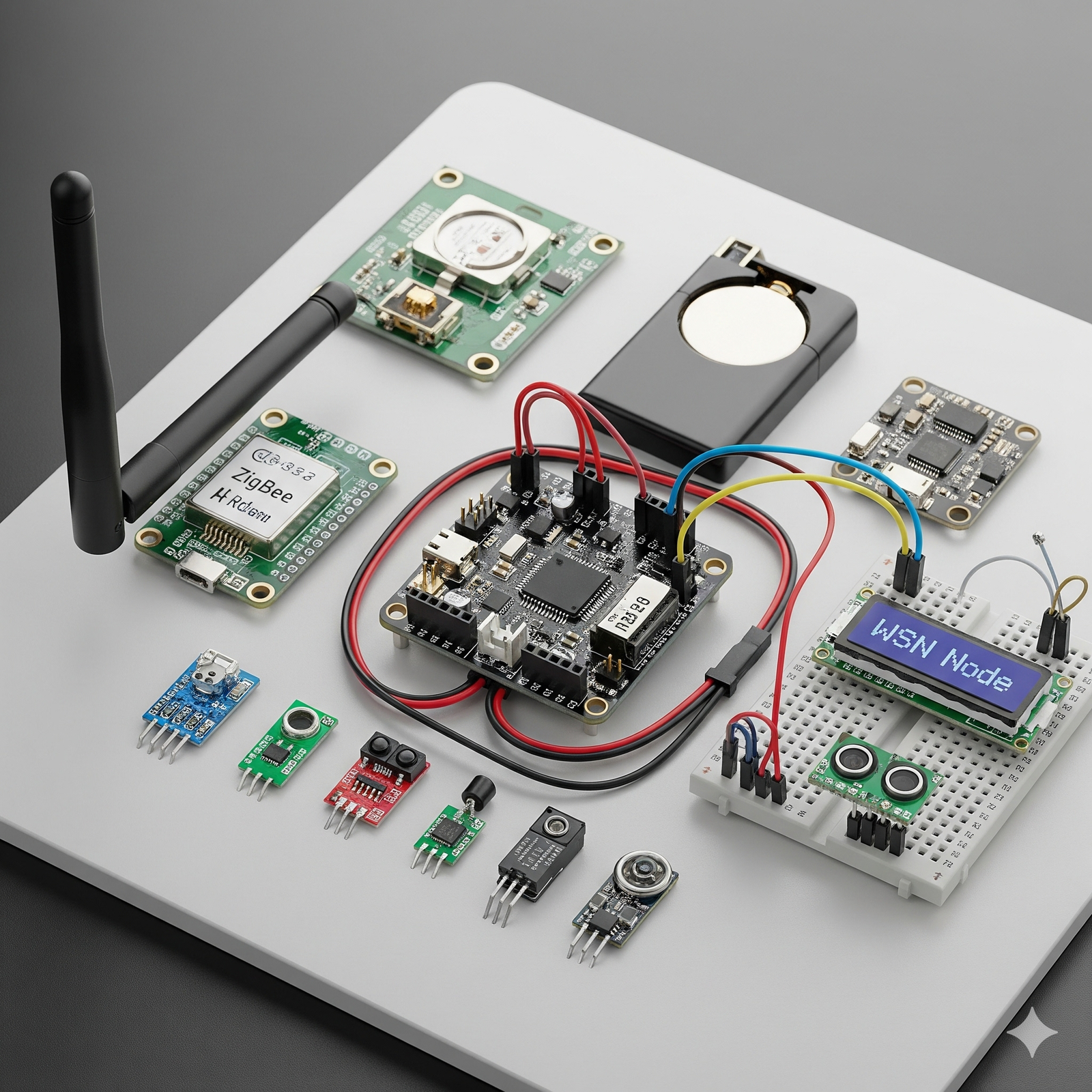
A collection of electronic components is neatly arranged on a light gray surface, including a central microcontroller with connected wires, a small breadboard with a display reading "WSN Node," various sensors in different colors, and modules like a Zigbee and a GPS unit.

Hardware Components

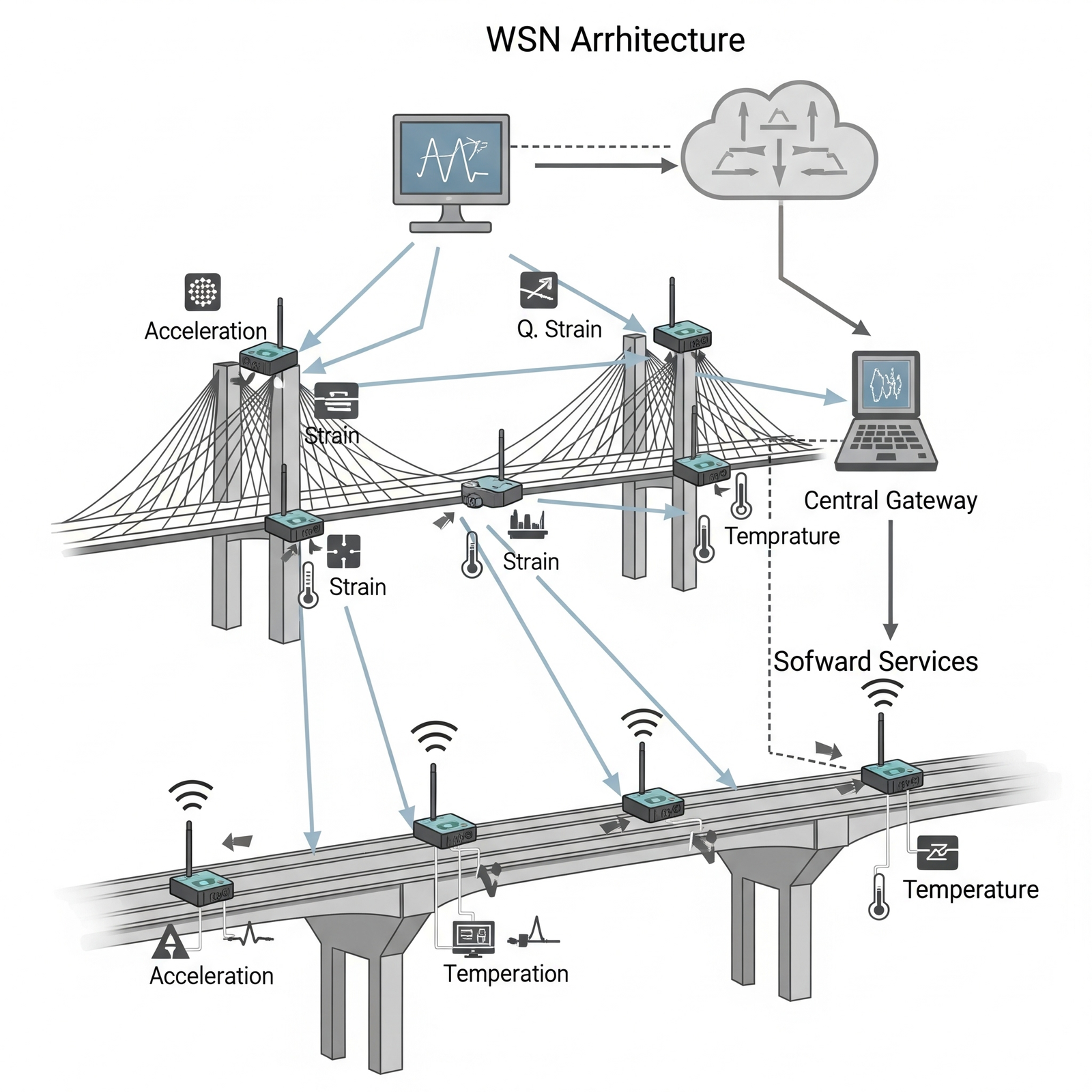
Smart Wireless Sensor Nodes Include accelerometers, strain gauges, tilt sensors, and thermocouples embedded in rugged enclosures.
Edge Computing Unit Enable localized processing of raw sensor data to reduce transmission loads and latency.
Wireless Gateways & Repeaters Ensure robust communication across large or complex sites using mesh or star topology.
Energy Modules Solar panels, long-life batteries, and energy harvesters ensure autonomous operation in remote environments.

A person sits at a desk in a dimly lit office, wearing headphones and working on a computer displaying colorful data visualizations and charts. A white mug and tablet are nearby, with shelves of documents in the background.

Software & Cloud Services

Data Acquisition Platforms Provide real-time data logging, visualization, and health index scoring.
Edge-to-Cloud Analytics AI-enabled diagnostics detect anomalies, fatigue, and threshold breaches.
Mobile & Desktop Dashboards For both field technicians and infrastructure managers.
APIs & SDKs Allow integration with existing enterprise asset management and BMS systems.
Key Features and Functionalities

Key features checklist

Wireless communication using ZigBee, LoRaWAN, or proprietary RF protocols

Key features checklist

Real-time or scheduled sensor sampling with adjustable frequency

Key features checklist

Edge-based analytics for event detection and data filtration

Key features checklist

Self-healing mesh network to maintain connectivity

Key features checklist

Long-range transmission up to several kilometers depending on terrain

Key features checklist

Low power consumption for years-long operation

Integrations and Compatibility

Structural Health Monitoring Systems

SCADA & Building Management Systems (BMS)

GIS platforms

Digital Twin infrastructure

Supports MQTT, OPC-UA, REST API for seamless platform integration

Benefits

Scalable & Modular

Expand across infrastructure as monitoring needs grow

Cost-Efficient

Eliminates high costs of wired sensor deployment

Rapid Deployment

Reduced downtime and labor requirements

Reliable Data

High-accuracy measurements across environmental conditions

Predictive Maintenance

Early failure detection enables proactive repairs

Applications

Applications

Bridge deflection and stress monitoring

Applications

High-rise sway and drift detection

Applications

Dam seepage and vibration analysis

Applications

Mining slope stability tracking

Applications

Tunnel convergence and deformation monitoring

Applications

Stadium and arena safety compliance

Applications

Offshore oil platform movement tracking

Industries We Serve

Civil & Structural Engineering

Transportation & Civil Infrastructure

A construction site with a partially built steel structure is equipped with digital sensors emitting blue signals. A worker in a hard hat and orange vest holds a tablet displaying data, while construction vehicles and materials are scattered around. A portable office is visible in the background.

Construction & Engineering

A bridge with various sensors, including vibration sensors and strain gauges, is shown with a data aggregation unit transmitting information to a hovering drone. The bridge spans over a body of water, with vehicles traveling across it, illustrating a smart infrastructure monitoring system.

Mining & Energy

A network of illuminated nodes is connected by glowing green lines across a rugged, hilly landscape at dusk. Each node, situated on a hilltop, features a small building with antennas. In the background, a brightly lit industrial facility is visible, adding a sense of technological advancement to the scene.

Utilities & Water Management

A futuristic oil refinery at dusk, featuring interconnected digital devices with glowing screens and Wi-Fi signals. Large storage tanks and pipelines are visible, with two control buildings displaying digital maps and data. Flames burn atop tall stacks in the background, illuminating the industrial setting.

Oil & Gas

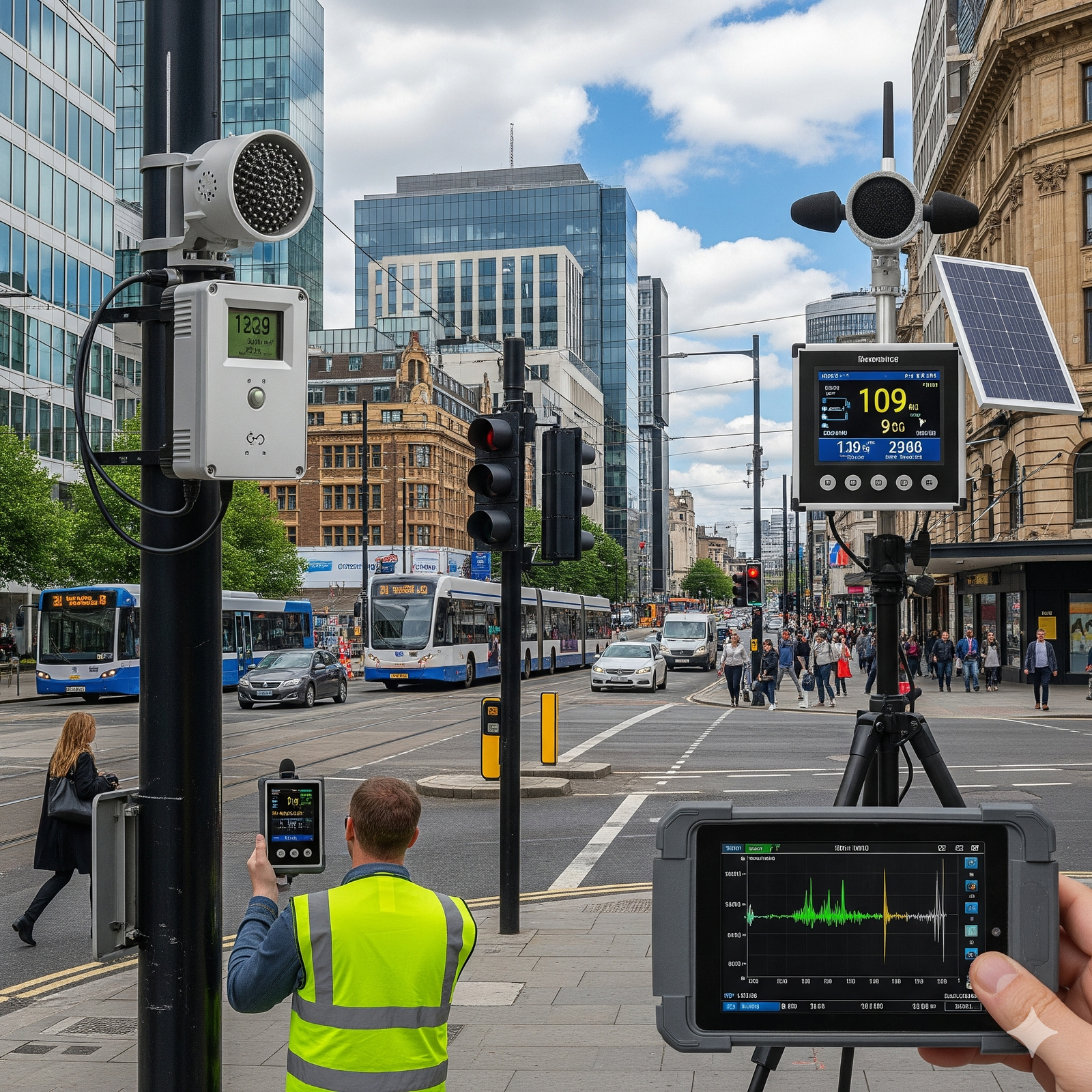
A person in a high-visibility vest operates a handheld device on a busy urban street, monitoring sound levels displayed on a screen. Nearby, a tripod supports another device with a digital readout, while buses and pedestrians move along the bustling cityscape surrounded by tall buildings.

Government & Public Safety

Relevant U.S. & Canadian Standards & Regulations

ANSI/ASCE 38

AASHTO LRFD Bridge Design Specifications

IEEE 1451

CSA S6: Canadian Highway Bridge Design Code

Case Studies

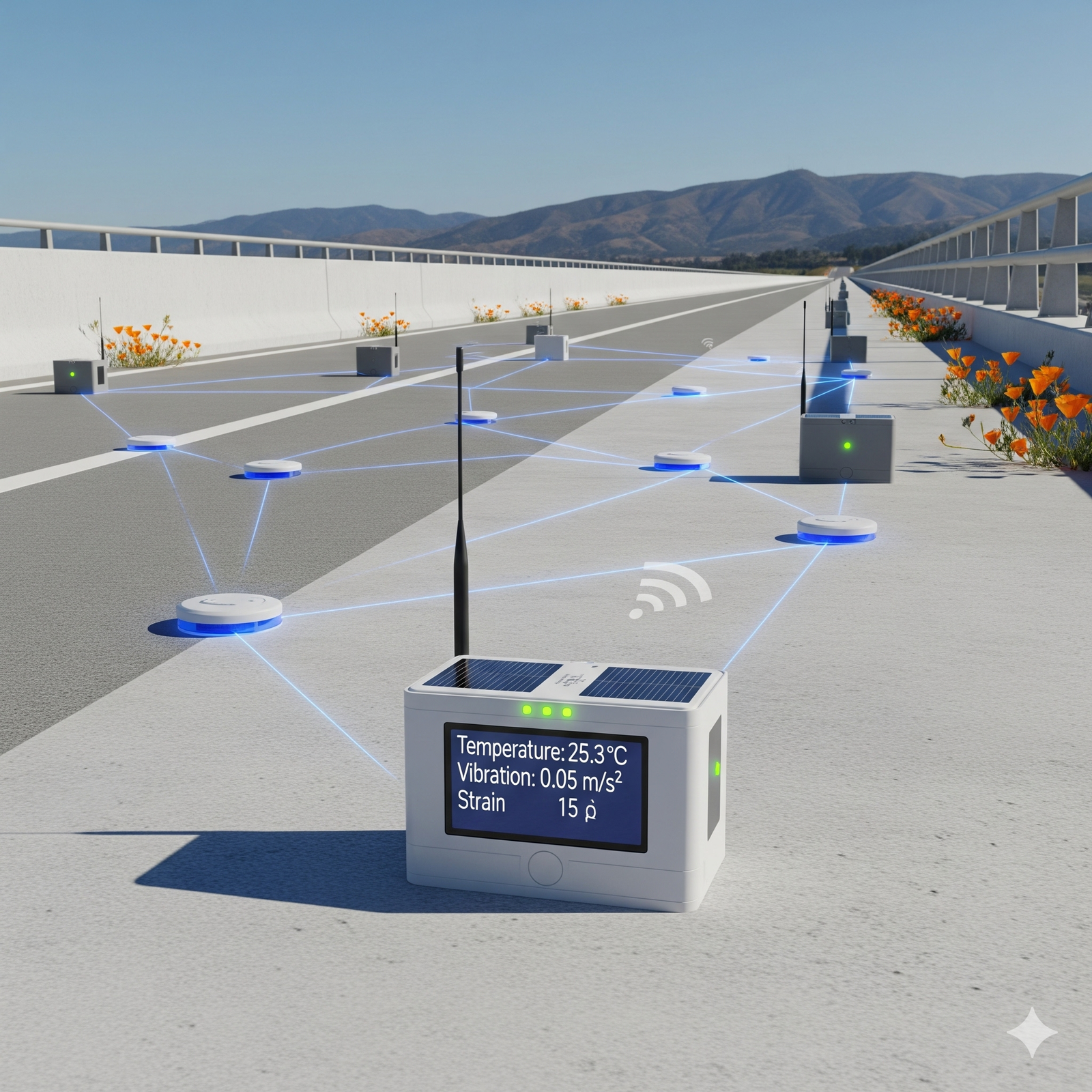
A network of small, solar-powered sensors is spread across a bridge, connected by blue lines. One sensor in the foreground displays temperature, vibration, and strain data. Bright orange flowers line the bridge, with mountains visible in the background.

Bridge Deck Monitoring (California, USA)

A municipal agency deployed WSNs across a large urban overpass to monitor stress concentrations and joint fatigue. With edge-processing and real-time alerts, they detected abnormal stress patterns during heatwave-induced expansion, allowing timely reinforcement. Result: 22% cost savings on emergency repairs and zero structural failures.
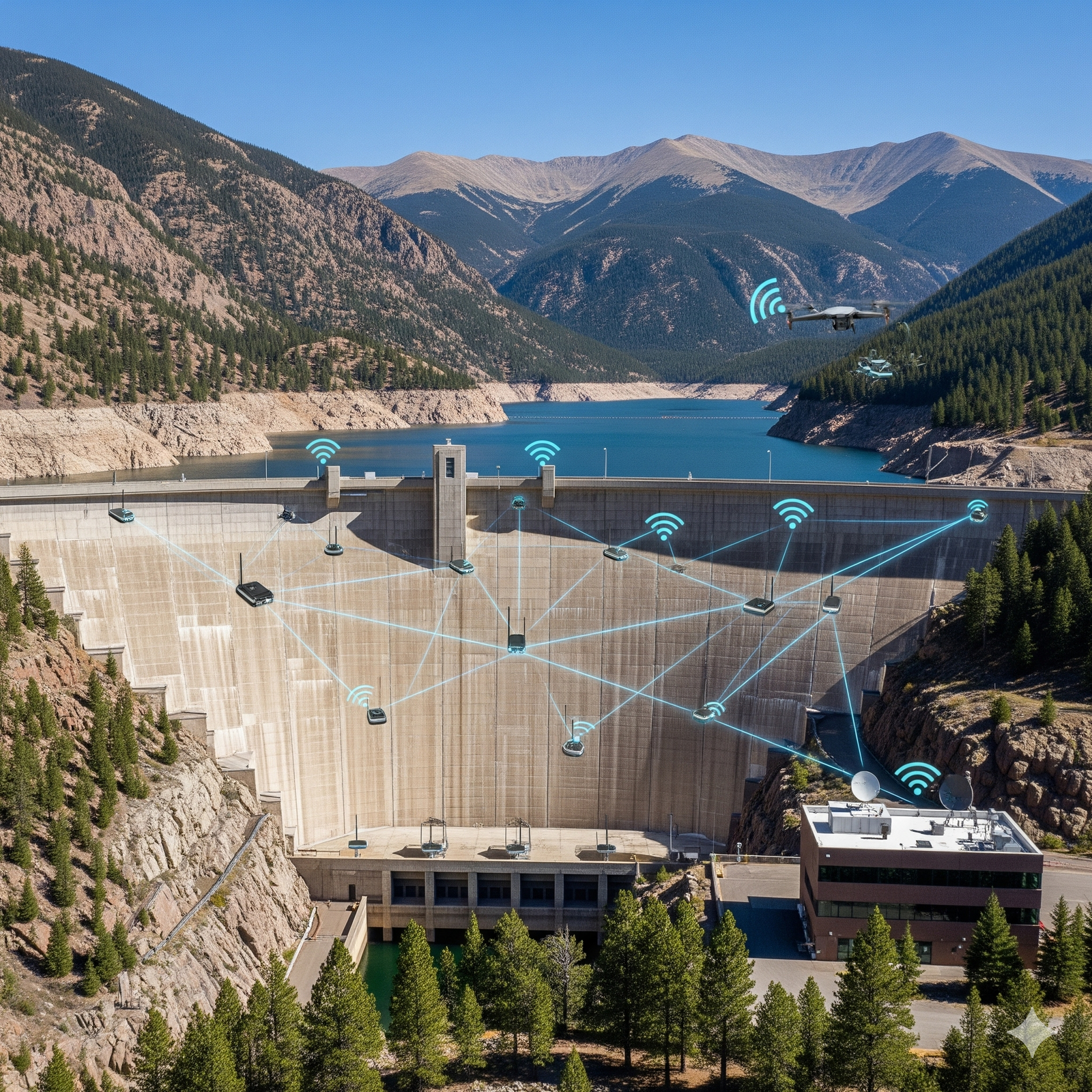
A large dam surrounded by mountains and a reservoir, with digital networks and wireless signals depicted. A drone and vehicles suggest advanced technology integration.

Smart Dam Surveillance (Colorado, USA)

An energy utility implemented WSNs for dam monitoring, tracking vibrations, water infiltration, and internal seepage. Integration with SCADA allowed seamless control room access. The early detection of micro-movements prevented a critical downstream flood scenario during heavy rains.

Urban High-Rise Monitoring (Toronto, Canada)

A property developer used WSNs during the construction and operation phases of a 60-story high-rise. Sensors provided real-time updates on settlement and frame deflection. Data was fed into a digital twin to simulate wind and seismic responses. The solution improved structural resilience assessments and facilitated better insurance underwriting.

Ready to modernize your infrastructure monitoring with wireless sensor networks? 

Contact Enviro Structural Monitoring for personalized consultation, custom integration support, or product inquiries. Let our team help you achieve safer, smarter, and more efficient operations.

An illustartion representing environment
Scroll to Top